The Ultimate Guide to Exterior House Painting Prices


Average Exterior House Painting Price in 2026
Planning an exterior renovation starts with understanding the broader market benchmarks. In 2026, the national average cost to paint a home exterior is $4,672, with most standard residential repaints falling between $4,276 and $5,655. Depending on home dimensions, siding substrates, and architectural intricacies, broader project quotes across the country typically span from $2,500 to $8,000.
When evaluating the Cost to Paint House Exterior, unit pricing provides a clear baseline. Professional contractors calculate quotes based on paintable square footage and structure height, generally charging between $2.50 and $5.00 per square foot of wall area for a comprehensive two-coat application. Single-coat maintenance refreshes typically range from $1.00 to $2.50 per square foot of wall surface.
Over the past five years, exterior painting prices have risen by 17.8%—climbing from an average of $3,821 in 2022 to over $4,500 today. This steady increase reflects rising labor wages, insurance rates, and material costs across the trade. As detailed in a comprehensive 2026 Exterior House Painting Cost Study, quote variations between professional painters are almost entirely driven by the hours dedicated to surface preparation and local crew rates rather than the price tag on the paint bucket.

Exterior House Painting Price Breakdown by Home Size and Stories
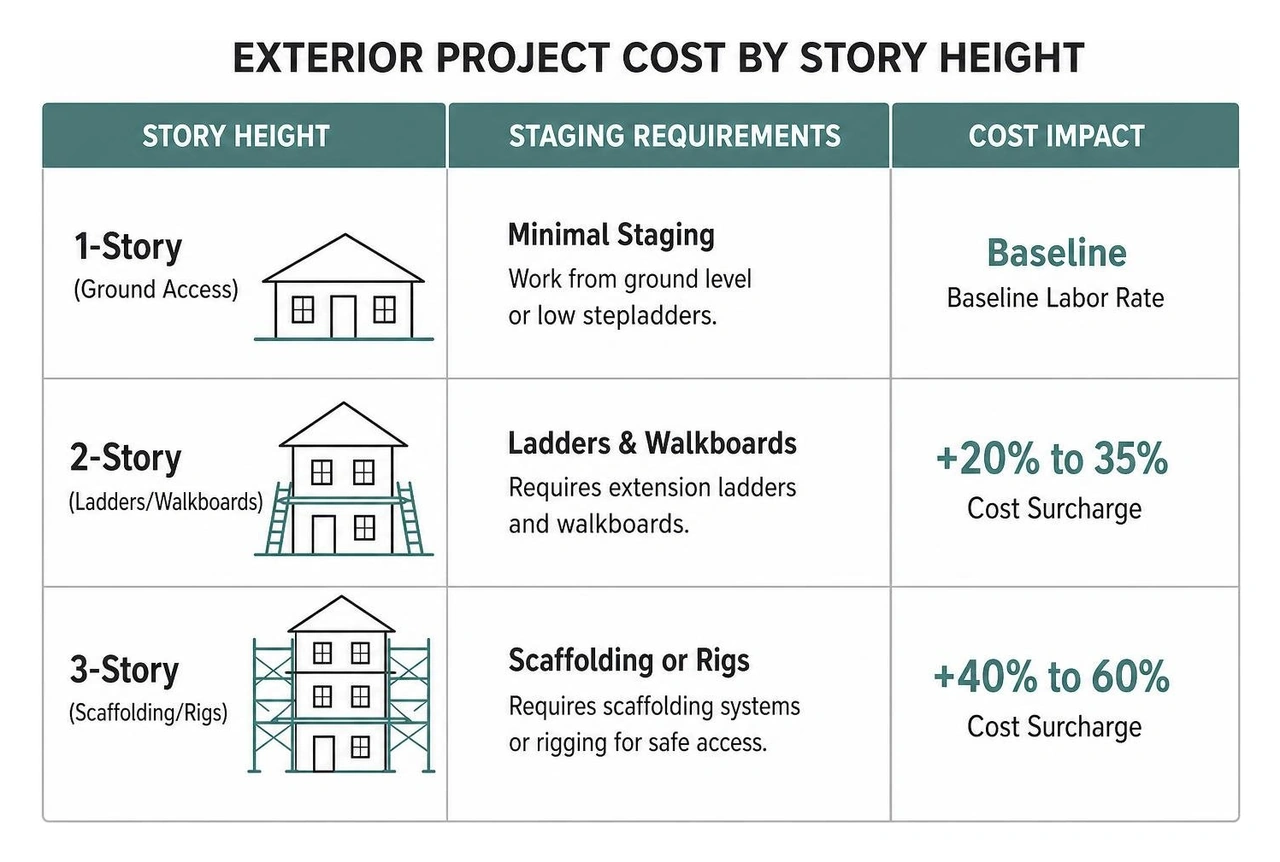
A home’s square footage and vertical profile are the most visible variables in any estimate. Single-story ranch homes require minimal staging, allowing crews to work quickly and safely from ground level or low stepladders. In contrast, multi-story residences demand significant labor hours just to set up extension ladders, maneuver walkboards, and assemble OSHA-compliant scaffolding systems.
On average, two-story homes carry a 20% to 35% cost premium over single-story homes with identical floor footprints. Painting a 2,500-square-foot, two-story house costs an average of $7,582, with typical project scopes landing between $5,844 and $9,321.
Here is how total project costs generally break down by home size and story height:
- 1,000 sq. ft. Home: Single-story ranches typically run between $1,500 and $3,500, while two-story layouts range from $2,000 to $4,500.
- 1,500 sq. ft. Home: A single-story residence ranges from $2,250 to $5,200, whereas a two-story design averages $3,000 to $6,800.
- 2,000 sq. ft. Home: Expect $3,500 to $6,500 for a one-story layout and $4,800 to $8,500 for a two-story profile.
- 2,500 sq. ft. Home: Single-story homes range from $3,750 to $8,000, while two-story models cost between $5,844 and $10,500.
- 3,000+ sq. ft. Home: Single-story configurations range from $4,500 to $9,500, with large two-story or multi-tier designs spanning $7,500 to $13,000+.
Exterior House Painting Price Variations by Siding Material
The physical substrate covering your home determines paint absorption, prep complexity, primer requirements, and application speed. Smooth, non-porous surfaces like vinyl and aluminum require less coating volume than rough, highly porous textures like stucco or unsealed brick.
- Vinyl Siding ($1.50 – $4.50 per sq. ft. of wall area): Vinyl requires careful washing and the application of vinyl-safe acrylic formulas with low solar absorption to prevent panels from warping under direct sunlight.
- Fiber Cement / Hardie Board ($1.75 – $4.75 per sq. ft. of wall area): Known for superior durability, fiber cement holds paint exceptionally well. The primary labor involves inspecting and recaulking butt joints and trim transitions before applying high-grade 100% acrylic latex.
- Aluminum Siding ($2.25 – $3.75 per sq. ft. of wall area): Oxidized or chalky aluminum requires specialized bonding primers or etching primers before topcoating to ensure the new finish bonds properly to the metal.
- Natural Wood Clapboard & Shingle ($2.50 – $4.25 per sq. ft. of wall area): Wood siding demands extensive manual preparation, including scraping peeled layers, feather-sanding edges, spot-priming bare grain with stain-blocking primers, and replacing rotted sections.
- Stucco Finishes ($2.45 – $5.50 per sq. ft. of wall area): Porous stucco siding "drinks" 25% to 40% more paint than smooth cladding. It often requires heavy-bodied masonry primers and flexible elastomeric coatings designed to span hairline settling cracks and allow trapped water vapor to escape.
- Painted Brick ($3.25 – $5.75 per sq. ft. of wall area): Painting brick requires specialized masonry primers and breathable mineral or silicate-based exterior coatings. The textured surface and deep mortar joints require heavy roller naps or spray-and-back-roll techniques, increasing both material consumption and labor time.
| Siding Material | Average Cost / Sq. Ft. (Wall Area) | Typical 2,000 Sq. Ft. Home Range | Key Application Requirements |
|---|---|---|---|
| Vinyl Siding | $1.50 – $4.50 | $3,000 – $6,500 | Vinyl-safe colors, mild detergent wash |
| Fiber Cement (Hardie) | $1.75 – $4.75 | $3,500 – $7,000 | Joint caulking, 100% acrylic latex |
| Aluminum Siding | $2.25 – $3.75 | $3,200 – $6,800 | De-chalking, corrosion-inhibiting primer |
| Natural Wood | $2.50 – $4.25 | $4,200 – $8,200 | Extensive scraping, sanding, oil/acrylic spot prime |
| Stucco | $2.45 – $5.50 | $4,500 – $9,200 | Elastomeric/breathable coatings, crack patching |
| Painted Brick | $3.25 – $5.75 | $5,000 – $10,500 | High nap back-rolling, breathable masonry paint |
Key Cost Drivers: Labor, Surface Area, and Material Splits
A professional paint estimate reflects a careful balance of labor hours, masking materials, specialized equipment, and premium coatings.
Understanding how contractors measure surfaces and allocate quote dollars helps homeowners evaluate line items with confidence.
Wall Area vs. Floor Area Pricing
A common point of confusion during project estimating is the difference between interior floor plan square footage and exterior paintable wall area. Homeowners often calculate budgets based on their home's interior living space (such as a 2,000-square-foot floor plan). However, professional trade estimates rely strictly on the vertical square footage of exterior walls.
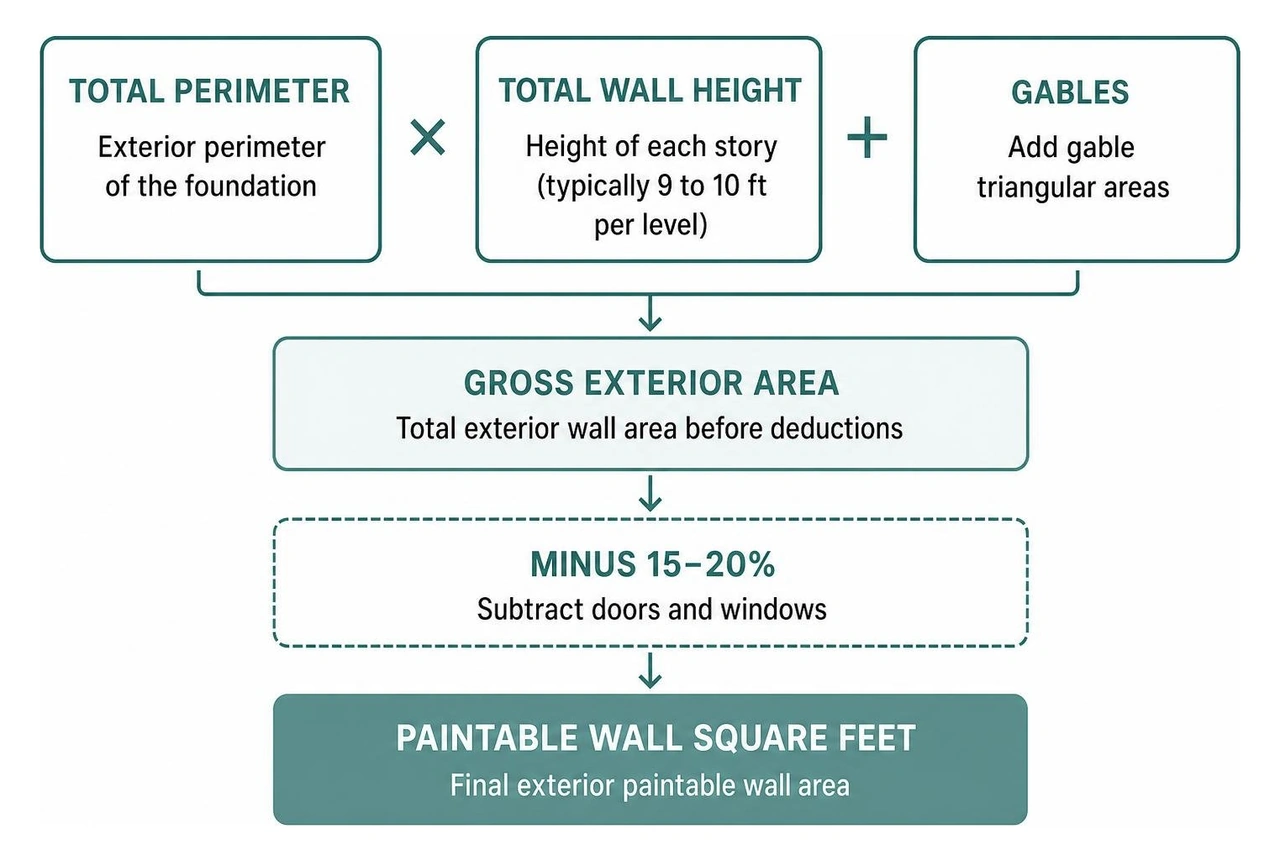
To determine paintable wall area, contractors calculate the exterior perimeter of the foundation, multiply it by the height of each story (typically 9 to 10 feet per level), add gable triangular areas, and deduct roughly 15% to 20% for window and door openings.
For instance, a two-story home with a 2,000-square-foot floor plan on a 40x25-foot foundation features a 130-foot perimeter. Multiplied by a 19-foot wall height, the gross wall area equals 2,470 square feet. Subtracting 18% for windows and entry doors leaves approximately 2,025 square feet of paintable surface.
As explained in the detailed guide on Exterior House Painting Cost per Square Foot (2026), unit rates for wall area generally translate to $1.75 to $3.45 per square foot of interior floor area for single-story homes, and $2.40 to $4.55 per square foot of floor area for two-story homes. Small standalone projects (such as painting a single detached garage or decorative porch) often bypass square footage formulas entirely, defaulting to standard crew daily minimums ($1,200 to $2,000) to cover fixed travel, mobilization, and ladder setup overhead.
Professional Labor vs. Premium Coating Expenses
Homeowners are often surprised to learn that paint cans represent a relatively modest portion of an exterior estimate. Paint and consumable supplies make up only 15% to 20% of the total cost, while professional labor, setup, surface preparation, and equipment operation account for 65% to 85%.
When looking at the Average Cost of Exterior Paint Job, a standard residential project breaks down across several core categories:
- Prep & Surface Cleaning Labor (35% – 40%): Pressure washing, scraping loose coatings, mechanical sanding, crack sealing, and spot priming.
- Application Labor (30% – 35%): Masking windows and roofs, ladder staging, precision brush cutting, spraying, and back-rolling.
- Coating Materials (15% – 20%): Premium 100% acrylic latex, elastomeric finishes, masonry primers, and specialty bonding sealers ($35 to $80+ per gallon).
- Job Supplies & Consumables (4% – 6%): Masking film, contractor paper, blue tape, specialty exterior caulking, drop cloths, and spray tips.
- Contractor Overhead & Insurance (10% – 15%): Commercial liability coverage, workers' compensation insurance, vehicle logistics, equipment maintenance, and project supervision.
Because labor represents the vast majority of the bill, upgrading from standard contractor-grade paint to a top-tier premium exterior coating typically adds only $600 to $1,000 to the total project price. Premium formulas contain higher concentrations of high-grade acrylic resins and titanium dioxide solids, extending the repaint cycle from 5 years to over 10 or 12 years—drastically reducing the overall annualized cost of maintaining your home.
Essential Preparation and Regional Price Factors
The longevity of an exterior paint job is determined almost entirely by the work done before a paintbrush ever touches the wall. Surface preparation accounts for up to 90% of paint film adhesion and lifespan.
Surface Prep, Pressure Washing, and Substrate Repairs
Standard surface preparation typically adds between $500 and $2,000 to an exterior project scope, depending on the age and condition of the existing coating. If a home has suffered years of sun baking or moisture intrusion, extensive restoration is necessary to create a sound bonding surface:
- Professional Power Washing ($200 – $500): Thoroughly removes embedded dirt, chalking paint residue, airborne contaminants, mildew, and algae spores.
- Scraping & Mechanical Feather-Sanding ($0.50 – $1.50 per sq. ft.): Removes peeling and flaking paint, followed by sanding the rough transition edges smooth so new paint films won't bridge or blister.
- Elastomeric Caulking & Sealing: Sealing gaps around window casings, door frames, fascia boards, and siding butt joints prevents water intrusion behind the siding.
- Specialty Spot Priming: Applying high-adhesion primers to bare wood, exposed masonry, rusted fastener heads, or tannin-rich knots to prevent bleed-through and topcoat detachment.
- EPA Lead RRP Compliance: For homes constructed prior to 1978, federal regulations mandate strict EPA Lead Renovation, Repair, and Painting (RRP) protocols. Certified contractors use specialized HEPA-shrouded scraping tools and heavy plastic drop-containment systems to prevent toxic lead-paint chips and dust from contaminating surrounding soil.

Climate and Regional Market Influences
Exterior painting prices and durability vary based on local climate conditions and regional labor markets. In the Carolinas—including our service areas across Charlotte NC, Concord NC, Gastonia NC, Matthews NC, Waxhaw NC, Fort Mill SC, and Indian Land SC—exteriors face intense summer heat, elevated ambient humidity, sudden thunderstorm downpours, and severe ultraviolet radiation.
These regional conditions require specific technical considerations:
- Mildew and Algae Resistance: High humidity and shaded woodlots accelerate mold and algae growth on North and South Carolina home exteriors, making biocide-fortified acrylic topcoats and regular washing essential.
- Substrate Expansion and Contraction: Rapid seasonal temperature swings cause siding substrates to expand and contract. Premium coatings with high elastic elongation prevent micro-cracking across joints and siding seams.
- Regional Wage Rates: Local trade labor rates across the Carolinas average between $25 and $75 per hour per technician (or $200 to $500 per day per painter). In North Carolina, average residential exterior painting projects land at approximately $4,050 (ranging from $2,250 to $7,200), while South Carolina averages $3,915 (ranging from $2,175 to $6,960).
When selecting trusted Exterior House Painters in Charlotte, verifying local business licensing, comprehensive general liability coverage, and dedicated workers' compensation insurance protects your property throughout the project.
Professional Strategies for Managing Painting Costs and Maximizing Longevity

Managing an exterior painting budget effectively means focusing on long-term value rather than cutting corners that lead to premature paint failure.
Repaint Timing and Seasonal Scheduling
Timing your project correctly ensures both optimal coating performance and competitive contractor scheduling:
- The Optimal Weather Window: Exterior coatings cure best when daytime ambient temperatures remain consistently between 50°F and 85°F with relative humidity levels below 70%. In our region, early spring through late autumn provides ideal conditions.
- Following the Sun: Experienced painting crews manage thermal surface conditions by following the sun around the house—working on west-facing walls in the morning and moving to east-facing elevations in the afternoon. This prevents coatings from flash-drying on hot surfaces above 95°F, which can cause poor film formation and blistering.
- Off-Peak Booking: Scheduling your exterior project during shoulder periods or booking early in the season can sometimes secure flexible contractor scheduling and seasonal promotional rates of 5% to 10%.
- Proactive Repainting Cycles: Repainting before widespread peeling occurs saves substantial labor costs. A home repainted while the existing film is intact requires only light power washing and spot priming, avoiding the expensive scraping and carpentry repairs of a neglected exterior.
Evaluating Professional Contractor Estimates
When comparing bids for your home's exterior, reviewing detailed line items ensures you are making a true apples-to-apples comparison:
- Itemized Scope of Preparation: Ensure the written proposal explicitly outlines power washing, scraping methods, caulking brands, and primer products. If a bid leaves out prep details, the contractor may plan to spray over dirty, flaking paint.
- Specified Coating Lines: The estimate should clearly state the exact paint manufacturer, product tier (e.g., premium 100% acrylic vs. contractor base), finish sheen, and the number of coats to be applied.
- Deposit and Payment Terms: Professional contractors typically request a modest mobilization deposit (10% to 20%), with progressive milestone draws and final payment due only after a comprehensive walkthrough inspection. Be cautious of contractors demanding 50% or more upfront before work begins.
- Verified Insurance Certificates: Always request direct proof of commercial general liability insurance and workers' compensation coverage for all crew members working on your property.
- Workmanship Warranties: Reputable painting contractors provide written warranties covering peeling, blistering, and coating detachment for 2 to 7+ years, demonstrating confidence in their surface prep and application standards.
Frequently Asked Questions About Exterior House Painting
How often should a home exterior be professionally repainted?
Most residential exteriors need professional repainting every 6 to 10 years, though specific timelines depend on the siding material, the quality of the previous paint application, and sun exposure:
- Natural Wood Siding: 5 to 7 years due to natural moisture absorption and grain expansion.
- Fiber Cement / Hardie Plank: 10 to 12 years due to its stable, non-expanding composite core.
- Stucco Finishes: 7 to 10 years, requiring regular checks for hairline surface cracks.
- Vinyl and Aluminum Siding: 8 to 12 years before noticeable chalking or UV fading occurs.
- Painted Masonry / Brick: 10 to 15+ years when applied with breathable masonry coatings.
What is the ideal weather window for exterior house painting?
The ideal conditions for exterior house painting are dry, overcast or mildly sunny days with temperatures between 50°F and 85°F and relative humidity below 70%.
Painting should be avoided during heavy rain, high winds, early morning dew, or late afternoon condensation. Professional crews stop applying water-based acrylic paints several hours before nightfall to allow the topcoat to form a protective skin before evening moisture settles on the surface.
Why does surface preparation make up such a large portion of the estimate?
Surface preparation accounts for 35% to 40% of total project labor because paint cannot adhere to chalky oxidation, airborne pollutants, mildew, or loose, flaking layers.
Skipping proper pressure washing, scraping, sanding, and priming leads to paint failure within 1 to 3 years. Thorough prep work performed by skilled professionals ensures your exterior coating system will bond tightly and protect your siding for 8 to 12 years or more.
Conclusion
A high-quality exterior paint job does far more than elevate your home's curb appeal—it serves as your home's primary defense against sun damage, driving rain, and seasonal humidity. While the national average exterior painting price in 2026 sits around $4,672, your actual investment depends on paintable wall area, home height, siding condition, and prep requirements.
By selecting high-grade acrylic coatings, prioritizing thorough surface prep, and partnering with experienced professionals, you protect your property and ensure a durable, beautiful finish.
At GW Painting Co., our team delivers licensed, insured, and detail-oriented Exterior Residential Painting across Charlotte, Concord, Gastonia, Matthews, Waxhaw, Fort Mill, and Indian Land. The cost of our painting services varies depending on the size and scope of the project. We offer free estimates to provide you with an accurate quote tailored to your specific needs. Contact our team today to schedule your on-site consultation.