Benjamin Moore Front Door Paint Colors to Boost Your Curb Appeal


Trending Benjamin Moore Front Door Palettes for 2026
The best Benjamin Moore front door paint colors for 2026 include Caliente (AF-290), a vibrant warm red; Hale Navy (HC-154), a crisp deep navy; and Wrought Iron (2124-10), a soft charcoal-black. For a premium finish, Benjamin Moore Aura Grand Entrance provides a luxurious, mirror-like enamel, while Aura Exterior offers superior fade resistance for doors in direct sun. These shades and formulas create a welcoming, visually anchored focal point that enhances your overall architectural design.
Exploring curated Benjamin Moore Front Door Paint Colors reveals a move away from flat, uninspired neutrals toward deeply saturated, complex hues that add distinct character. When choosing paint colors for your exterior entryway, the goal is to balance timeless elegance with personal flair.
Top-Rated Benjamin Moore Front Door Paint Colors for Every Facade
Every home presents a unique mix of brick, stone, roofing, and siding. Selecting a color that harmonizes with these elements elevates the entire facade.
Here are the standout Benjamin Moore shades:
The Statement Reds:
- Caliente (AF-290): A vibrant, charismatic red with a hint of warm undertone. It creates an energetic, welcoming focal point on modern farmhouses and traditional colonials alike.
- Heritage Red (HC-181): A classic, deep architectural red from the Historical Collection. It offers a rich, timeless look that pairs naturally with natural red brick and stone masonry.
- Cottage Red (PM-15): A rustic, grounded country red with deep earthy undertones, ideal for craftsman and cottage exteriors.
- Million Dollar Red (2003-10): A bright, high-impact, uncompromising red designed to draw the eye immediately from the curb.
The Sophisticated Darks and Navies:
- Hale Navy (HC-154): The benchmark deep navy. It features subtle slate undertones that keep it looking crisp and refined without turning royal blue under direct sunlight.
- Wrought Iron (2124-10): A soft, muted charcoal-black that provides high contrast without the harshness of a true pitch black. It complements nearly every siding shade.
- Black Iron (2120-20): A rich, dense near-black that creates a clean, tailored finish on transitional and contemporary entrances.
- Black Forest Green (PM-12): An ultra-deep blackened forest green that brings historic grandeur and subtle organic depth to neutral facades.
The Expressive Greens, Teals, and Yellows:
- Aegean Teal (2136-40): A balanced blend of blue, green, and gray that adds a soothing, coastal-inspired warmth.
- Essex Green (HC-188): A deep, traditional hunter green that pairs seamlessly with natural wood accents and warm earth tones.
- Bumblebee (2018-20): A bright, cheerful yellow that provides a lively pop of personality on white, light gray, or navy homes.
- Yellow Raincoat (2020-40): An optimistic, clear yellow that delivers an inviting accent on coastal and cottage facades.
The Soft Neutrals and Subtle Accents:
- Saybrook Sage (HC-114): A tranquil, silvered green that blends harmoniously with lush landscaping and natural stone pathways.
- Palladian Blue (HC-144): An airy, soft blue-green that reflects gentle light across covered porches.
- Boothbay Gray (HC-165): A versatile, mid-tone historic gray with cool blue undertones that offers a sophisticated, understated entry.
- Cinder (AF-705): A refined, cool medium-dark gray that delivers a clean, modern aesthetic.
Light Reflectance Value and Exterior Lighting Dynamics
Light Reflectance Value (LRV) measures the percentage of light a paint color reflects on a scale from 0 (absolute black, absorbing all light) to 100 (pure white, reflecting all light). Understanding LRV is essential for exterior doors:
- Deep Accent Range (LRV 2–20): Most statement front door colors—such as Hale Navy (LRV ~8), Caliente (LRV ~9), and Wrought Iron (LRV ~8)—fall in this bracket. These shades provide grounding visual weight, hide everyday scuffs, and create a strong focal point against lighter exterior facades.
- Soft Architectural Accents (LRV 20–55): Mid-tone shades like Aegean Teal (LRV ~25) and Saybrook Sage (LRV ~45) soften the transition between exterior siding and interior spaces while maintaining sufficient color presence.
- Light Tones (LRV 55+): Softer tones such as Palladian Blue (LRV ~60) reflect abundant light, brightening recessed or covered entryways that receive minimal natural sunlight.
Lighting orientation also changes how colors appear throughout the day. A south- or west-facing door receives intense, warm natural sunlight that can wash out lighter pastels or cause deep warm tones to read brighter. Conversely, north-facing porches receive indirect, cool-toned light that can make deep greens and charcoals appear nearly black.
Our professional painting crews factor these lighting conditions into every color consultation to ensure your selected shade delivers its intended depth across all hours of the day.
Selecting the Best Benjamin Moore Front Door Paint Formulas and Sheens
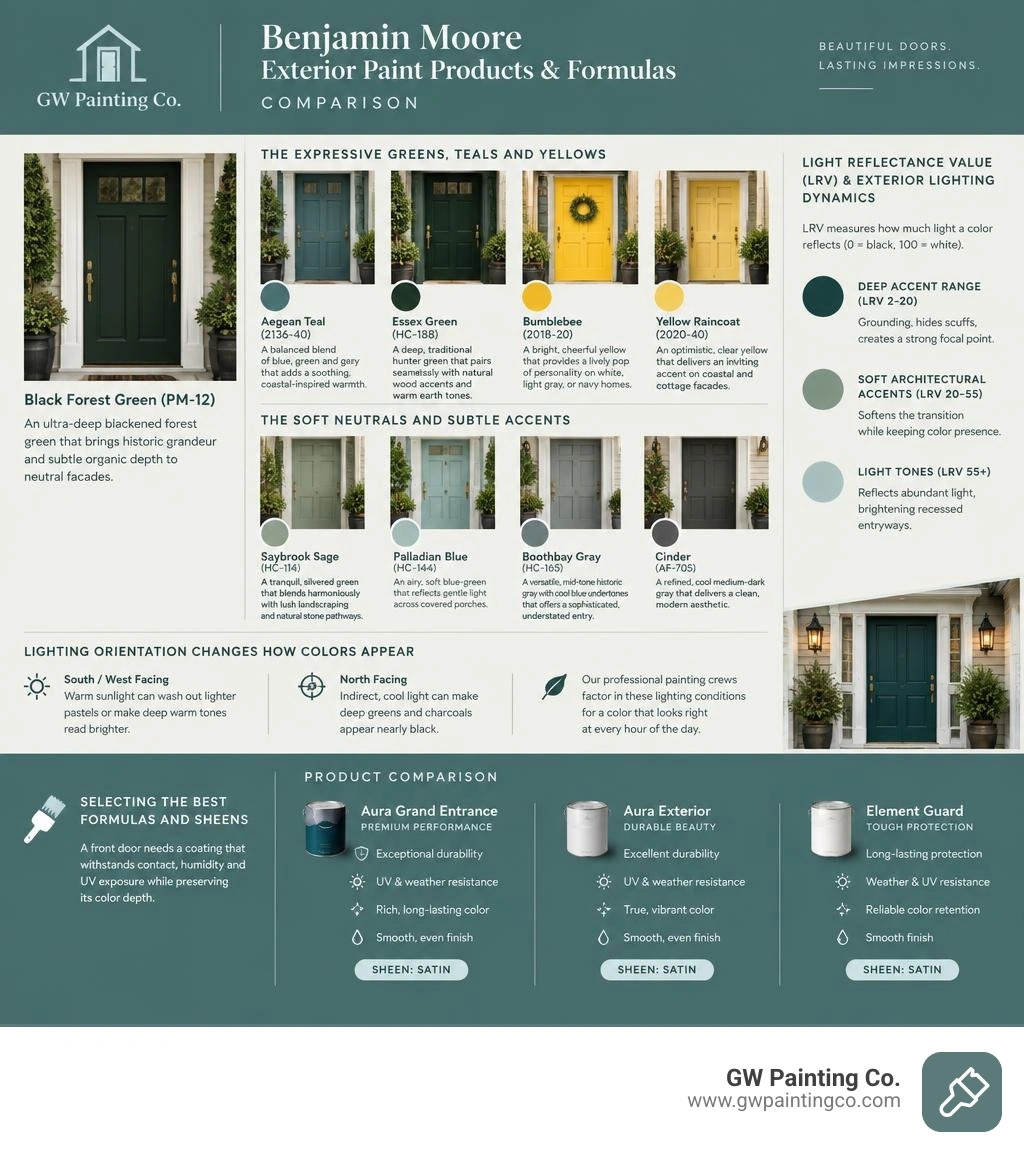
A front door requires a coating that withstands frequent contact, fluctuating humidity, and direct UV exposure while preserving its color depth. Benjamin Moore provides specialized formulations engineered for exterior doors and trim.
Product Comparison: Grand Entrance vs. Aura Exterior vs. Element Guard
| Feature / Metric | Aura Grand Entrance | Aura Exterior | Element Guard |
|---|---|---|---|
| Resin Technology | Urethane-Modified Waterborne Alkyd | 100% Acrylic Proprietary Color Lock | Advanced Acrylic Co-Polymer |
| Primary Specialty | Luxurious, mirror-like enamel finish | Superior fade resistance & deep color retention | Moisture & early rain resistance |
| Ideal Architectural Styles | Saturated reds, deep navies, high-gloss statement entries | Soft architectural neutrals, matte/satin architectural millwork | Humid, rain-exposed, high-moisture entryways |
| Typical Longevity | 8–12 years on covered entries | 12–15 years in all sun exposures | 8–10 years in harsh weather zones |
| Available Sheens | Satin, High Gloss | Flat, Low Lustre, Satin, Soft Gloss | Low Lustre, Flat, Soft Gloss |
According to the Benjamin Moore Grand Entrance Technical Data, Grand Entrance uses a specialized urethane-modified alkyd that levels smoothly like an oil-based enamel while maintaining low-VOC waterborne cleanability.
For deep, saturated hues such as Heritage Red or Black Iron, Grand Entrance provides unmatched visual richness. For soft, earthy architectural tones or doors exposed to full afternoon sun, Aura Exterior delivers long-lasting UV stability and color retention.
Selecting the Right Sheen: High-Gloss, Semi-Gloss, and Satin
The sheen level influences both the visual impact of your door and its day-to-day durability:
- High-Gloss: Delivers a reflective, glass-like finish reminiscent of classic European entryways. It maximizes color depth on dark tones and saturated reds, making the door an unmistakable architectural feature. Because high gloss highlights surface textures, our painters perform extensive sanding and leveling before application.
- Semi-Gloss / Soft Gloss: The most versatile option for residential entryways. It offers a subtle, luminous sheen, exceptional scrub resistance, and excellent moisture protection without over-accentuating minor substrate imperfections.
- Satin: Provides a soft, velvety luster that complements historical properties, craftsman homes, and modern rustic architecture. It excels at preserving the warmth of earthy tones like Saybrook Sage and Boothbay Gray.
Coordinating Door Colors with Siding, Brick, and Architectural Accents

A front door should harmonize with fixed elements that remain unpainted, such as roof shingles, brickwork, stone masonry, and hardscaping. Professional designers assess these fixed materials to create a balanced, cohesive exterior palette. Scheduling a professional color consultation helps eliminate guesswork by evaluating your home's undertones alongside surrounding landscaping.
Facade Matching Guide: White, Gray, Brick, and Green Homes
- White & Off-White Siding: A crisp white home serves as a versatile canvas. Saturated contrast colors like Hale Navy, Caliente, or Wrought Iron create a tailored, classic aesthetic. For a coastal or cottage look, softer hues like Aegean Teal or Palladian Blue introduce gentle, inviting color.
- Gray & Charcoal Facades: When working with gray siding, identify whether the undertone is warm (greige) or cool (blue-slate). Cool grays pair naturally with Black Iron, Wrought Iron, or Yellow Raincoat. Warm gray exteriors coordinate beautifully with rich reds or deep architectural greens like Essex Green.
- Natural Brick Exteriors: Brick contains multifaceted undertones ranging from burnt orange and terra cotta to deep plum. Deep slate tones like Wrought Iron, historic navy like Hale Navy, or classic Heritage Red accentuate traditional brick masonry. For a modern, earthy balance, deep bronze-browns like Bracken Brown (HC-78) create a warm, unified entrance.
- Sage Green & Earth-Tone Homes: Sage green siding harmonizes with earthy neutrals and deep contrasting accents. Deep charcoal-blacks, warm whites, or rich wood-toned finishes provide clear contrast, while soft gold and mustard accents deliver a vintage-inspired look.
Door, Shutter, Trim, and Sidelight Harmony Rules
Balancing architectural trim, shutters, and sidelights ensures your home looks well-proportioned:
- Shutters vs. Door: Shutters do not need to match the front door identically. Pairing dark charcoal shutters (such as Wrought Iron) with a bold statement door (such as Caliente) creates visual interest while keeping the exterior balanced.
- Trim and Millwork Casings: Exterior door trim and porticos are typically finished in a crisp, durable trim white or deep contrasting accent to cleanly frame the entrance.
- Sidelights and Transoms: If sidelights sit within the primary door frame, painting them the trim color helps the front door stand out as the central focal point. In wider entryways with detailed architectural framing, painting the sidelights to match the door can make the entrance appear larger.
- Hardware Pairings: Unlacquered brass and warm gold hardware look striking against deep navies, greens, and blacks. Matte black and brushed bronze hardware add a refined finish to warm reds and crisp neutral doors.
Professional Prep, Priming, and Substrate Application Standards
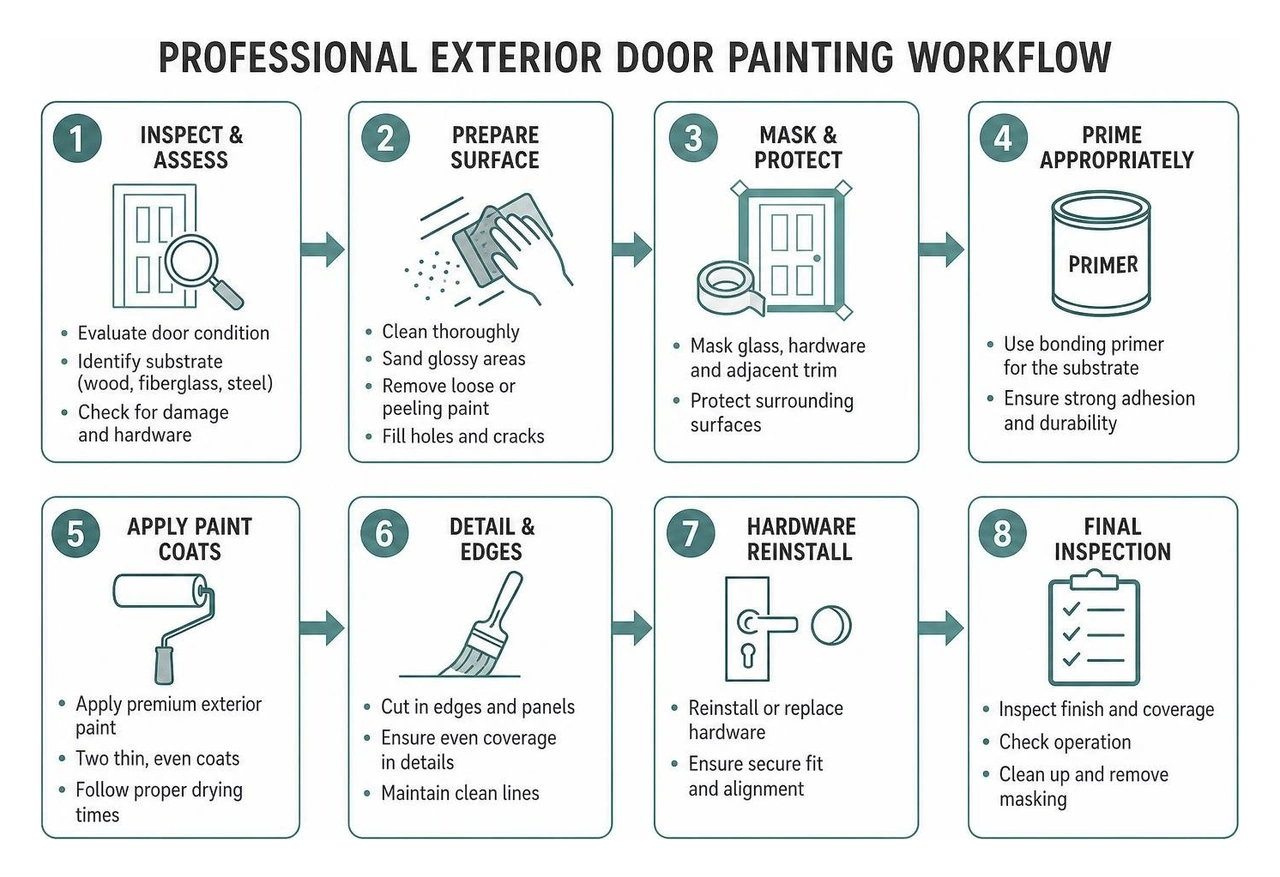
A showroom-quality finish on a front door requires careful preparation. As professional exterior specialists, our crews follow strict surface preparation standards before opening a can of paint. You can explore our detailed process in our exterior door painting complete guide, and review how door updates fit into broader home renovations in our breakdown of the average cost of exterior paint job.
Substrate Requirements: Wood, Fiberglass, and Steel Doors
Different exterior door substrates require tailored preparation methods and bonding primers:
- Wood Doors: Natural wood expands and contracts with shifting humidity. We thoroughly clean, scrape, sand, and spot-repair loose grain before applying a premium bonding primer such as Fresh Start Multi-Purpose Latex or High-Hiding Primer. This stabilizes the wood and prevents moisture intrusion.
- Fiberglass Doors: Smooth and wood-grain textured fiberglass requires specialized preparation. The surface must be de-glossed and coated with a high-adhesion acrylic bonding primer to ensure the finish coats adhere without chipping or peeling.
- Galvanized Steel Doors: Steel surfaces must be completely free of oxidation and factory oils. We clean and apply a dedicated corrosion-inhibiting primer, such as Ultra Spec HP Acrylic Metal Primer, creating an ultra-smooth surface for enamel finish coats.
- Deep Base Color Priming: When applying rich reds like Caliente or deep blacks like Black Iron, professional crews apply a tinted gray primer. This neutral base allows topcoats to achieve complete opacity and true color depth in fewer coats.
How Professionals Test and Apply Benjamin Moore Front Door Paint
Achieving a smooth, brushmark-free finish requires careful environmental control and application technique:
- Color Validation: We assess physical color swatches and test boards in direct natural daylight and evening porch lighting against your siding and masonry.
- Hardware Removal & Masking: All locksets, knockers, weatherstripping, and glass panels are removed or protected with professional-grade masking tape.
- Surface Leveling: The substrate is sanded with progressively finer grits to remove imperfections, ridges, and previous application marks.
- Controlled Application: We apply two full coats of premium Benjamin Moore exterior enamel using fine-finish spray equipment or specialized synthetic brushes and micro-flock rollers, maintaining optimal wet-edge leveling.
- Curing Management: Finish coats require strict temperature ranges (ideally 50°F to 90°F) and low ambient humidity to ensure a smooth, durable cure that resists daily wear.
Frequently Asked Questions About Front Door Painting
What is the most popular Benjamin Moore red front door paint?
Caliente (AF-290) remains the most popular Benjamin Moore red for front doors. It provides a modern, balanced red with warm undertones that avoids looking pink or orange under bright sun. For historic properties, Heritage Red (HC-181) is a close favorite, delivering a deeper, traditional brick-red tone.
How long does a professional Benjamin Moore front door finish last?
When applied over a properly primed substrate, Benjamin Moore Aura Grand Entrance lasts approximately 8 to 12 years on covered porches, while Aura Exterior provides 12 to 15 years of exceptional UV and weather protection on doors exposed to direct afternoon sun.
Can Benjamin Moore exterior paint be applied over fiberglass and steel doors?
Yes. With the correct prep work and specialty acrylic bonding primers (such as Fresh Start High-Hiding Primer for fiberglass or Ultra Spec HP Acrylic Metal Primer for steel), premium Benjamin Moore products like Grand Entrance and Aura Exterior bond securely to both fiberglass and metal doors.
Conclusion
Your front door is the focal point of your home's exterior, greeting guests and framing your entryway. Updating it with premium Benjamin Moore front door paint protects your door against weather while significantly boosting curb appeal. From vibrant statement reds to deep, sophisticated navies and soft organic greens, the right color and product formula can transform your entrance for years to come.
GW Painting Co. provides licensed, insured, and detail-oriented painting services throughout the Charlotte, NC metro area—including Concord, Gastonia, Matthews, Waxhaw, and Fort Mill and Indian Land, SC. Our respectful, professional crews handle every phase of surface preparation, priming, and fine finish application to deliver a smooth, long-lasting result backed by our satisfaction guarantee.
The cost of our painting services varies depending on the size and scope of the project. We offer free estimates to provide you with an accurate quote tailored to your specific needs. Contact GW Painting Co. today to explore our exterior residential painting services and schedule your front door transformation.