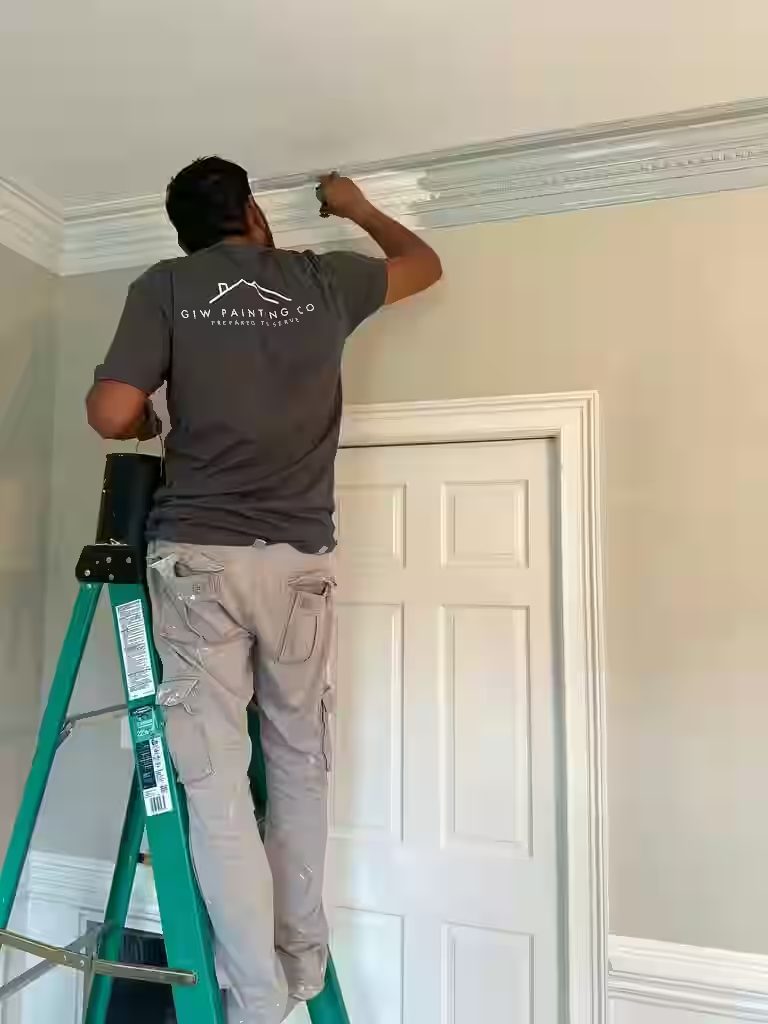
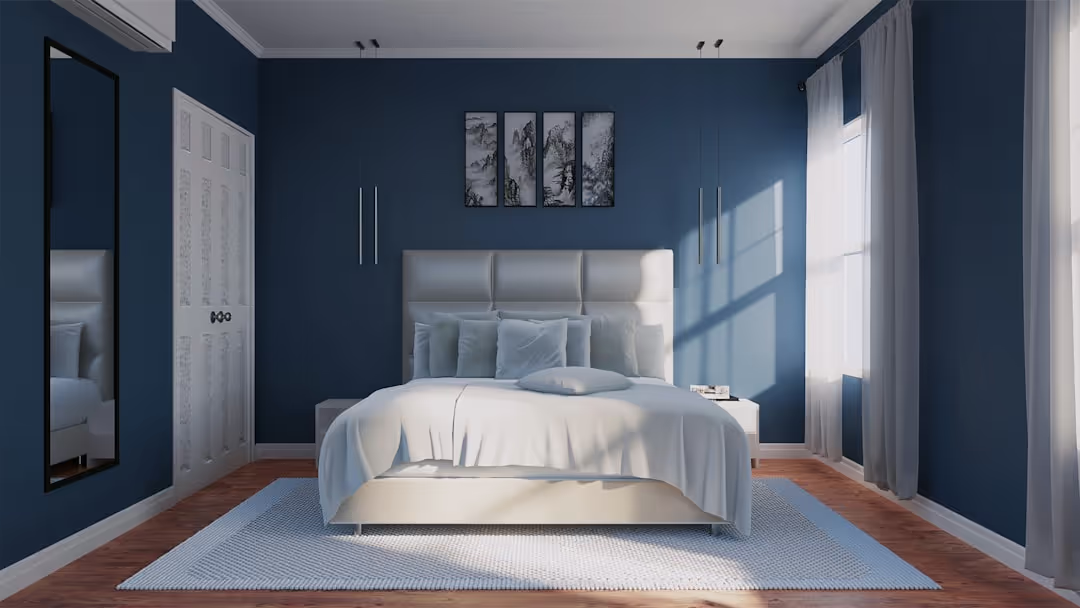
.avif)

Painting a Room: Uncovering the Average Price Tag
.avif)

.svg)

Why Understanding Professional Painting Costs Matters

The average charge for painting a room typically ranges from $400 to $1,600, with most homeowners spending around $1,100 for a standard-sized room. This cost varies based on room size, wall condition, ceiling height, and material quality.
A challenge for homeowners is that painting quotes can look similar at a glance, while the scope of work behind them can be very different. Two contractors may both say they will "paint a bedroom," but only one may include full surface preparation, proper priming, premium materials, and a written warranty. Understanding what drives pricing helps you compare estimates fairly and prevents surprise charges mid-project.
Quick Cost Breakdown:
| Room Size | Price Range | Typical Timeline |
|---|---|---|
| Small (10' x 10') | $500 - $1,200 | 1-2 days |
| Medium (12' x 12') | $800 - $1,800 | 2 days |
| Large (15' x 20') | $1,200 - $2,500 | 2-3 days |
Refreshing your home with a new coat of paint is an investment in property value and daily comfort. It can also be a practical way to protect drywall, trim, and high-traffic surfaces from wear, scuffs, and staining when the right products and prep steps are used.
The painting industry lacks standard pricing, leading to variations between contractors. The difference lies in the service quality. Professional painting includes:
- Detailed masking and protection for flooring, furniture, and fixtures
- Surface prep (cleaning, patching, sanding, caulking, and spot priming)
- Consistent coverage and crisp lines around trim, ceilings, and corners
- Product selection matched to the room (durability, washability, and sheen)
- Cleanup, final walkthrough, and support if touch-ups are needed
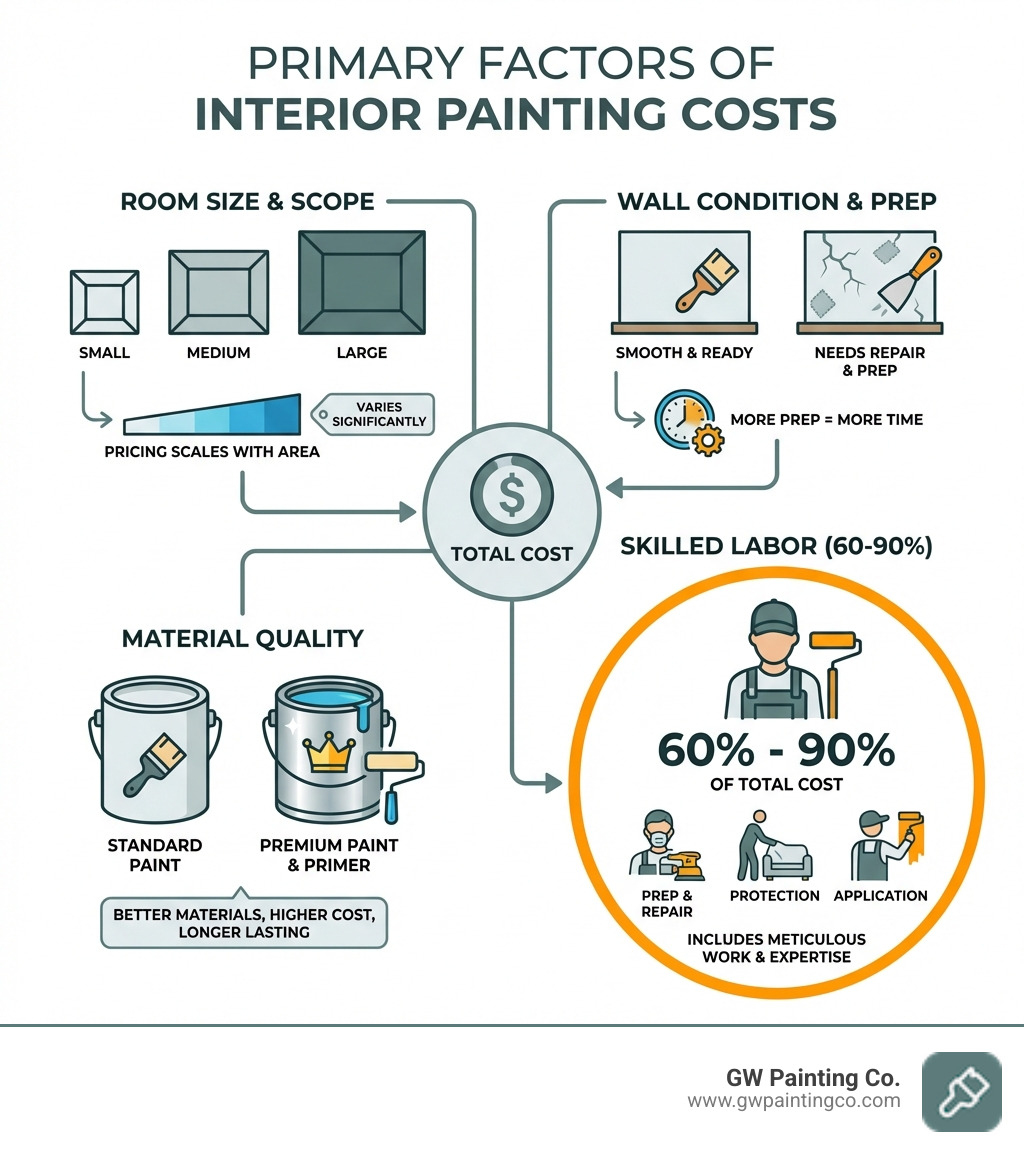
Labor represents 60% to 90% of your total cost, covering furniture protection, repairs, sanding, and precision application. Materials make up the remainder. At GW Painting Co., we provide transparent, custom quotes for every project, and our licensed, insured crews work cleanly and respectfully in homes throughout Charlotte, Concord, Fort Mill, Indian Land, Matthews, Waxhaw, Gastonia, and nearby communities.
Understanding the Average Charge for Painting a Room
For homeowners in Charlotte, Concord, Fort Mill, and across the Carolinas, the average charge for painting a room usually falls between $400 and $1,600. While national data suggests an average of $613, local market factors can drive costs higher or lower. Generally, interior painting costs between $2 and $10 per square foot, including labor and materials. For more details, see our resource on Paint Cost Per Room.
What does that range include? In a professional quote, you are paying for far more than paint on walls. Most reputable contractors price a room as a complete scope: protecting the home, preparing surfaces, applying the agreed number of coats, and leaving the space clean. When you compare estimates, look closely at whether ceilings, trim, doors, closets, and minor drywall repairs are included or listed as add-ons.
How Room Size Impacts the Average Charge for Painting a Room
Larger rooms require more paint, primer, and labor. We calculate costs based on perimeter measurements and wall height. A small room (10' x 10') might cost $500-$1,200, while a large room (15' x 20') can range from $1,200 to $2,500. Since a gallon of paint covers 350-400 square feet, larger spaces naturally increase material and application time.
Room size affects more than just wall area. Bigger rooms often have more openings and details (multiple doors, larger windows, long baseboards), and that added cut-in work can extend the project even when wall square footage is similar. Ceiling height matters too: an 8-foot room and a 10-foot room with the same footprint have very different wall surface area.
To avoid pricing surprises, a professional measure typically accounts for:
- Wall square footage and ceiling height
- Number of doors and windows (and whether they are painted)
- Amount of baseboard, crown molding, and other trim
- Closets, alcoves, and stairwell transitions that require extra cutting-in
Regional Variations in the Average Charge for Painting a Room
Painting costs vary by location due to the local cost of living and prevailing wages. Labor rates in a major hub like Charlotte may differ from smaller surrounding towns. Demand in growing areas like Fort Mill or Indian Land also influences pricing. Data from the Occupational Employment and Wage Statistics shows how professional wages fluctuate by metropolitan area.
In the greater Charlotte region, pricing can also shift based on scheduling demand and travel logistics. For example, homes in dense neighborhoods may require additional time for parking, loading/unloading, and protecting adjacent finished areas, while larger properties in suburban communities may have more square footage and trim per room. A trustworthy estimate should reflect your specific home and clearly state what is included, rather than relying on a one-size-fits-all number.
Breaking Down Labor and Material Expenses
The average charge for painting a room is split between labor (60-90%) and materials (10-40%). Understanding this breakdown helps homeowners see the value of professional expertise.
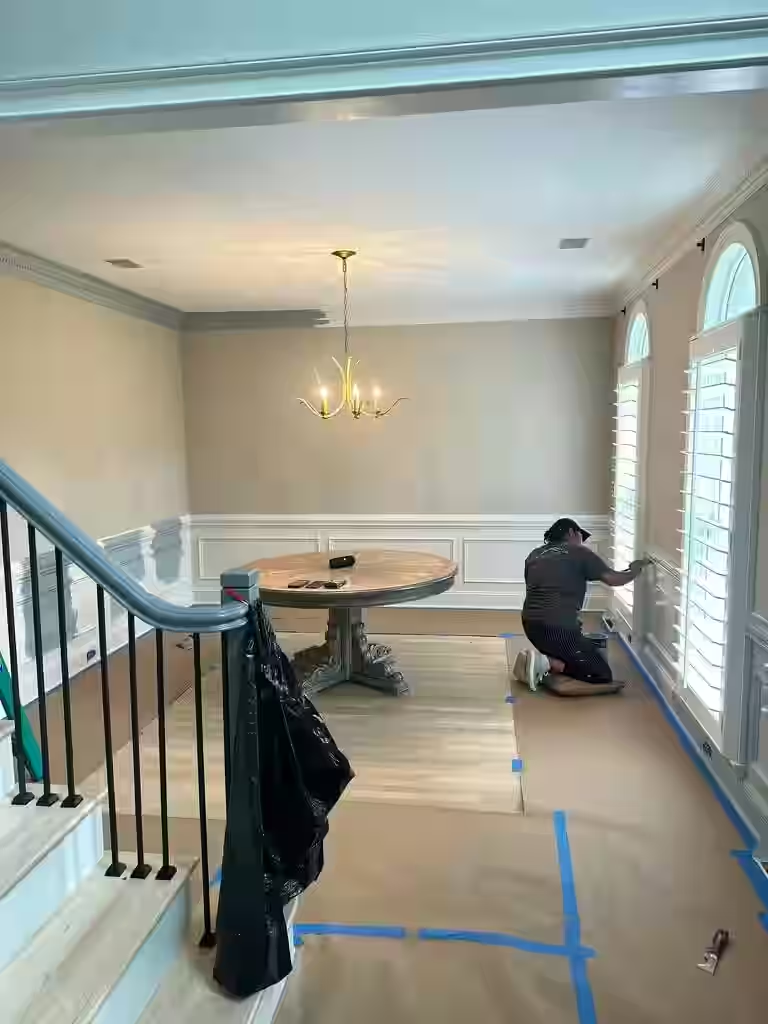
A professional interior paint job is process-driven. When pricing is extremely low, it often means steps are being reduced: minimal prep, fewer coats, lower-grade paint, or limited protection and cleanup. When pricing is higher, you are usually paying for durability and consistency, especially in high-visibility spaces like living rooms, foyers, and open-concept areas.
Professional Labor Rates
While hourly rates average around $60, we typically provide flat-rate pricing for transparency. Labor costs cover essential preparation work, including furniture protection, wall cleaning, patching, sanding, and priming. This meticulous prep ensures a long-lasting finish that meets the highest professional standards.
Labor also includes the skilled parts of the job that are hard to see in a quick estimate:
- Masking and safeguarding floors, countertops, and fixtures
- Cutting-in clean lines at ceilings, corners, and trim
- Applying consistent coats with the correct dry times between them
- Managing ventilation, odor control, and jobsite cleanliness
Crew size and workflow affect timeline and cost. A single painter may take longer but can still produce excellent results; a two-person crew can reduce disruption and complete a typical room more efficiently. Flat-rate proposals help you understand total project cost upfront, rather than tracking hours.
Material Grades and Finishes
- Paint Quality: Budget paints cost $20-$30 per gallon, while premium brands exceed $50-$70. High-quality paint offers better coverage and durability.
- Sheen Selection: Finishes range from flat/matte to high-gloss. Higher sheens are more durable for trim but may require more careful application.
- Primer: Essential for sealing surfaces and ensuring uniform color, primer costs about $10 per quart.
- Contractor Discounts: GW Painting Co. receives 20-40% discounts on materials, allowing us to use premium products while keeping your budget in check.
Materials also include more than paint and primer. Professional projects commonly require:
- Caulk and patching compounds for gaps and minor repairs
- Sandpaper, abrasives, and dust-control supplies for smooth finishes
- Masking paper/plastic, tape, and protective floor coverings
- Applicators (roller covers, brushes), trays, and cleanup materials
The goal is not just to change color, but to deliver a finish that looks even in different lighting and holds up to everyday use. That is why product selection (washability, scrub resistance, stain blocking) and correct primer use can meaningfully impact the final cost and long-term value.
Key Factors That Influence Professional Painting Quotes
Ceiling Height
Standard 8-foot ceilings are the most affordable. Vaulted or cathedral ceilings require ladders, extension poles, or scaffolding, which increases labor time and safety requirements.
Ceiling height also affects the amount of cutting-in at the ceiling line and can require different application techniques to maintain a uniform finish. In taller spaces, crews often work in stages to keep edges wet and avoid lap marks, which adds time compared to a standard-height room.
Architectural Details and Trim
Intricate crown molding, wainscoting, and built-ins require precise cutting-in and multiple coats. Similarly, painting baseboards, door frames, and window sills is a detailed task that adds to the overall labor cost.
Even when the wall color is straightforward, detailed trim packages can take as long as the walls. Quotes typically rise with:
- Multiple doors (bedrooms with closets, bathrooms, and connecting doors)
- Larger window casings and stools
- Chair rails, picture-frame molding, or paneled wainscoting
- Built-ins, shelving, and fireplace surrounds
Wall Condition and Preparation
Professional results depend on surface prep. Our process includes cleaning, sanding, patching holes, and caulking gaps. This preparation can cost $0.50 to $0.75 per square foot but is vital for durability. For technical standards, see the HUD PATH Rehab Guide.
Prep needs vary widely between homes. For example, rooms with heavy wall anchors, nail pops, or previous patchwork may require additional sanding and spot priming to prevent flashing (where repaired areas show through the finish). High-gloss existing paint may need deglossing so the new coating bonds properly.
Accessibility and Room Complexity
Moving heavy furniture or working around complex built-ins adds labor time. Homeowners can often reduce costs by clearing the room before the crew arrives.
Accessibility also includes how easy it is to set up safely. Tight staircases, narrow hallways, or rooms filled with large furniture can slow down protection and prep. When a space is hard to stage, painters may need to work in smaller sections to avoid bumping wet walls or damaging belongings. A detailed quote should account for these conditions so the timeline and pricing stay realistic.
Hidden Costs and Specialized Surface Preparation
Unexpected Repairs
Initial estimates may change if prep work reveals stress cracks, water damage, or mold. We recommend a 10-15% contingency fund for these unforeseen issues. We always discuss repairs with you before proceeding.
Some issues are not visible until the room is cleaned, sanded, or primed. For instance, stains can bleed through the first coat if the surface needs a stain-blocking primer, and hairline cracks may open up after sanding. A professional contractor should document any newly finded issues, explain options, and price changes clearly before work continues.
Specialized Finishes and Features
- Drywall Repair: Significant repairs can add $600+ to a budget. Skim coating for a smooth finish costs $1.10-$1.30 per square foot.
- Texture Matching: Matching orange peel or knockdown textures adds $1-$3 per square foot.
- Wallpaper Removal: This labor-intensive task costs roughly $3 per square foot.
- Popcorn Ceiling Abatement: Removing textured ceilings typically costs $1-$2 per square foot.
- Accent Walls: Contrasting colors require extra taping and precision, slightly increasing labor costs.
Specialty work changes the production pace because it involves additional steps, drying time, and careful blending to make repairs or textures disappear under finish paint. When you are reviewing an estimate, note whether these items are included in the base scope or listed as optional services.
If your home was built before 1978 and you suspect older coatings, it is also reasonable to ask your contractor about their approach to lead-safe practices and how that could affect preparation and cleanup requirements. (Professional painters should follow applicable regulations and prioritize occupant safety.)
How to Evaluate a Professional Painting Estimate
A professional estimate should be a detailed roadmap. At GW Painting Co., we provide written quotes covering the scope of work, material specs, and timelines. For more on our process, visit our Interior Residential Painting page.
A strong estimate makes it easy to compare contractors on equal ground. If two quotes are far apart, the reason is usually found in the details: prep level, number of coats, which surfaces are included (walls only vs. walls plus ceilings/trim/doors), and the quality of the paint system.
Reading the Fine Print
Ensure your contract includes the number of coats, specific paint brands, preparation steps, cleanup protocols, and warranty details.
Other items that help protect you as a homeowner include:
- Clear start and completion dates (or a stated timeline range)
- Explicit inclusions/exclusions (for example, whether closets, ceilings, doors, or trim are included)
- Change-order language for any additional repairs finded after work begins
- Proof of insurance and confirmation that the contractor is licensed where required
Questions to Ask Your Contractor
- Are you licensed and insured?
- What is your crew's experience level?
- Can you provide local references?
- What are your payment terms? (Avoid full payment upfront)
- How do you protect my belongings?
- Do you offer a satisfaction guarantee?
You can also ask how they handle touch-ups and punch-list items at the end of the job, and whether the quoted paint system is designed for your space (for example, more washable finishes for hallways, kids' rooms, and other high-traffic areas). Clear answers are often a sign of a well-run, professional operation.
Frequently Asked Questions about Painting Costs
How much does it cost to paint a 12x12 room?
A 12x12 room typically costs between $800 and $1,800. The final price depends on wall condition, ceiling height, and the amount of trim work required.
Does the time of year affect painting prices?
Yes. Spring and summer are peak seasons with higher demand. Scheduling during fall or winter may offer more flexibility and competitive pricing.
Why is it more efficient to have the professional contractor provide the paint?
Professional contractors receive 20-40% discounts and have the expertise to estimate quantities accurately, preventing waste and ensuring the right product is used for the surface.
Conclusion
The average charge for painting a room reflects the value of professional craftsmanship and quality materials. From prep work to the final coat, every detail matters. GW Painting Co. provides top-rated, licensed, and insured services across Charlotte and the Carolinas. Ready to refresh your home? Explore our Services and contact us today for a free estimate!